EE 351
Homework 2
Due at 11:59pm on Thursday, April 16th. Submit to https://canvas.uw.edu/courses/1883403/assignments/11376146 . It is fine to submit scanned or a picture of handwritten answers, but we must be able to read it. Indicate your final answer clearly, show your work. Each problem is 10 points (all subproblems weighted equally).
Problem 1
Consider the following circuit:

Find
a) The power (active and reactive) delivered to the load.
b) The power (active and reactive) coming out of the source.
Solutions.
The total impedance is
\[Z_{\text{total}} = Z_{\text{line}} + Z_{\text{load}} = 6 + j7\ \Omega\]and the magnitude of the current is
\[\vert I \vert = \vert \frac{V_s}{Z_{\text{total}}} \vert = \vert \frac{120}{6 + j7} \vert = 13.02\ \text{A}\]a)
\[P_{\text{load}} = |I|^2 \cdot R_{\text{load}} = 847.06\ \text{W}\] \[Q_{\text{load}} = |I|^2 \cdot X_{\text{load}} = 338.82\ \text{VAr}\]b)
\[P_{\text{source}} = |I|^2 \cdot R_{\text{total}} = 1017.65\ \text{W}\] \[Q_{\text{source}} = |I|^2 \cdot X_{\text{total}} = 1185.88\ \text{VAr}\]Problem 2
Consider the circuit shown above.
a) Suppose we want to achive unity power factor at the load (that is, a power factor of 1) by adding a capacitor in parallel. Find the size of the capacitor (in unit of \(\Omega\)).
b) Now we want to tune the capacitor such that the source to only delievers active power. Is it possible? Explain why or why not.
Solutions.
a) The load impedance is: \(Z_{\text{load}} = 5 + j2\ \Omega\) So the load admittance is:
\[Y_{\text{load}} = \frac{1}{Z_{\text{load}}} =\frac{5}{29} - j\frac{2}{29}\ \text{S}\]To achieve unity power factor at the load, the capacitor must cancel the imaginary part of \(Y_{\text{load}}\) and \(Y_C = j\frac{2}{29}\ \text{S}\).
Since \(Y_C = \frac{1}{Z_C} = j\frac{1}{X_C}\), we have \(X_C = \frac{29}{2} = 14.5\ \Omega\). And the capacitor impedance is: \(Z_C = -j14.5\ \Omega\)
b) For the source to deliver only active power, the total input impedance seen from the source must be purely real.
\[Z_{\text{total}} = Z_{\text{line}} + \frac{1}{Y_{\text{load}} + Y_C}\]Let \(Y_C = jB_C\) where \(B_C > 0\). The combined load admittance is:
\[Y_{\text{combined}} = \frac{5}{29} + j\left(B_C - \frac{2}{29}\right)\]The combined load impedance is:
\[Z_{\text{combined}} = \frac{1}{Y_{\text{combined}}}\]Let \(G = \frac{5}{29}\) and \(B = B_C - \frac{2}{29}\), so:
\[Z_{\text{combined}} = \frac{G - jB}{G^2 + B^2}\]The total impedance is:
\[Z_{\text{total}} = \left(1 + \frac{G}{G^2 + B^2}\right) + j\left(5 - \frac{B}{G^2 + B^2}\right)\]For the source to deliver only active power, the imaginary part must be zero:
\[5 - \frac{B}{G^2 + B^2} = 0 \implies \frac{B}{G^2 + B^2} = 5\] \[B = 5(G^2 + B^2)\] \[5B^2 - B + 5G^2 = 0\]Substituting \(G = \frac{5}{29}\):
\[5B^2 - B + \frac{125}{841} = 0\]It is easy to check that this equaiton has no real solution. This means it is not possible to achieve unity power factor at the source by only adding a capacitor in parallel with the load, given this line impedance.
Problem 3
Consider a load supplied by a 120V (rms) AC source. The load is a \(1 \ \Omega\) resistance in parallel with a \(100 \ mH\) inductor. Find
a) Active power delivered to the load in North America
b) Active power delivered to the load in Europe
Solutions.
Since the resistor and inductor are in parallel, the voltage across each element is the same as the source voltage \(V_s = 120\ \text{V}\).
The active power is only consumed by the resistor:
\[P = \frac{V_s^2}{R} = \frac{120^2}{1} = 14400\ \text{W} = 14.4\ \text{kW}\]Note that the frequency does not affect this result, since the voltage across the resistor is fixed at \(V_s\) regardless of frequency. This is the answer to both a) and b).
Problem 4
A voltage source \(V = 220\angle 120^\circ\) is connected across a load consisting of a \(15\ \Omega\) resistance in series with a \($100\ \mu\text{F}\) capacitance. Assume the circuit is energized in the United States. Find the load power factor.
Solutions.
We have \(X_C = \frac{1}{2\pi 60 C} = 26.526\ \Omega\) and \(Z = R - jX_C = 15 - j26.526\ \Omega\)
The current is $I = \frac{V}{Z} = 7.220\angle180.52°\ \text{A}$$. The power delievered to the load is
\(S = V I^* = (220\angle120°)(7.220\angle{-180.52°})= 781.1 - j1382.6\ \text{VA}\) and
\[\text{pf} = \frac{P}{\vert S \vert} = \frac{781.1}{1588.4} \approx 0.492\ \text{(leading)}\]Problem 5
An electric load consists of a \(15\ \Omega\) resistance in series with a \(10\ \Omega\) inductive reactance. The load is connected in parallel with another load of unknown impedance. The voltage source of the system is \(220\ \text{V}\). The total real and reactive powers delivered by the source are \(4\ \text{kW}\) and \(2\ \text{kVAR}\), respectively. Compute the impedance of the unknown load. State the real and reactive components.
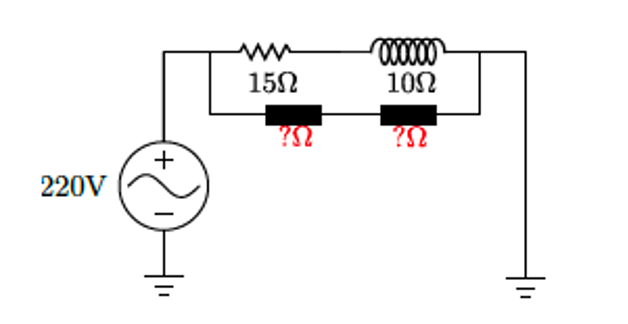
Solutions.
The current through Load 1:
\[\vert I_1 \vert = \vert \frac{V_s}{Z_1}\vert = 12.206\ \text{A}\]Real and reactive power of Load 1:
\[P_1 = \vert I_1 \vert^2 R_1 = 2233.8\ \text{W}\] \[Q_1 = \vert I_1 \vert^2 X_1 = 1489.2\ \text{VAR}\]Power consumed by the other load is
\[P_2 = P_{\text{total}} - P_1 = 1766.2\ \text{W}\] \[Q_2 = Q_{\text{total}} - Q_1 = 510.8\ \text{VAR}\]The complex power of Load 2 is \(S_2 = P_2 + jQ_2 = 1766.2 + j510.8\ \text{VA}\). Since the loads are in parallel, the voltage across Load 2 is also \(V_s = 220\ \text{V}\):
\[S_2 = \frac{\vert V_s\vert^2}{Z_2^*} \implies Z_2^* = \frac{|V_s|^2}{S_2} = \frac{220^2}{1766.2 + j510.8}\] \[Z_2^* = \frac{48400}{1766.2 + j510.8} = \frac{48400(1766.2 - j510.8)}{1766.2^2 + 510.8^2}= 25.28 - j7.31\ \Omega\]Taking the conjugate:
\[Z_2 = 25.28 + j7.31\ \Omega\]Problem 6
A \(630\ \text{V}\) AC voltage source is connected to two parallel connected impedances. One impedance draws \(10 + j15\ \text{kVA}\), and the other impedance draws \(15 - j10\ \text{kVA}\).
a) Find the source current.
b) A capacitor is added in parallel such that the source delievers power at unity power factor. Find the value of the capacitor (in \(\Omega\)).
Solutions.
a) The total complex power supplied is \(S=10+j15+15-j10=25+j5\ \text{kVA}\). Using \(S = V \cdot I^*\), \(I^* = \frac{S_{total}}{V_s} = \frac{(25+j5)\times 10^3}{630} = 39.68 + j7.94 \ \text{A}\). Taking conjugate, \(I_s = 39.68 - j7.94 = 40.47\angle{-11.31^\circ} \ \text{A}\)
b) For unity power factor, the source delivers zero reactive power. So the capacitor supplies \(Q_C = -5 \ \text{KVAr}\). Using \(Q_C = -\dfrac{\vert V\vert^2}{X_C}\), we can solve for \(X_C\) and get
\[X_C = \frac{630^2}{5000} = 79.38 \ \Omega\]The capacitor impedance is: \(Z_C = -j79.38 \ \Omega\)
Problem 7
A buck converter has a source voltage \(V_s = 15\ \text{V}\) and a load resistance \(R = 15\ \Omega\). If the duty ratio of the transistor is \(60\%\), compute the following:
a) Voltage across the load
b) Power delieved to the load
Solutions.
a) For a buck converter:
\[V_o = K \cdot V_s = 0.6 \times 15 = 9 \ \text{V}\]b) \(P = \frac{V_o^2}{R} = \frac{9^2}{15} = \frac{81}{15} = 5.4 \ \text{W}\)
Problem 8
A boost converter has a source voltage \(V_s = 10\ \text{V}\) and a load resistance \(R = 2\ \Omega\). If the duty ratio of the transistor is \(50\%\), compute the following:
a) Voltage across the load
b) Power delieved by the source
Solutions.
a) For a boost converter:
\[V_o = \frac{V_s}{1-K} = \frac{10}{1-0.5} = \frac{10}{0.5} = 20 \ \text{V}\]b) Since the converter is ideal, power delivered by source equals power delivered to load:
\[P = \frac{V_o^2}{R} = \frac{20^2}{2} = \frac{400}{2} = 200 \ \text{W}\]Problem 9
A boost converter is used to step up \(30\ \text{V}\) to \(50\ \text{V}\). The switching frequency of the transistor is \(5\ \text{kHz}\), and the load resistance is \(25\ \Omega\). Compute the following:
(a) The current ripple when the inductor is \(L = 7.5\ \text{mH}\)
(b) The average current of the load
(c) The power delivered by the source
Solutions.
The duty ratio is \(K = 1 - \frac{V_s}{V_o} = 1 - \frac{30}{50} = 0.4\)
a) \(\Delta I_L = \frac{V_s \cdot K \cdot T}{L} = \frac{30 \times 0.4 \times 0.2\times10^{-3}}{7.5\times10^{-3}} = 0.32 \ \text{A}\)
b) \(I_o = \frac{V_o}{R} = \frac{50}{25} = 2 \ \text{A}\)
c) Since the converter is ideal, power delivered by source equals power delivered to load:
\[P = V_o \cdot I_o = 50 \times 2 = 100 \ \text{W}\]