EE 351
Homework 1
Due at 11:59pm on Thursday, April 9th. Submit to https://canvas.uw.edu/courses/1883403/assignments/11346093. It is fine to submit scanned or a picture of handwritten answers, but we must be able to read it. Indicate your final answer clearly, show your work. Each problem is 10 points (all subproblems weighted equally).
Problem 1
Let \(A\) and \(B\) denote the complex numbers: \(A = -3 - j2\) and \(B = \sqrt{5}\angle 20^\circ\). Find
(a) The polar representation of \(A\) (angle in degrees)
(b) \(A + B\) in rectangular coordinates
(c) \(A - B\) in polar coordinates
(d) \(AB\) in rectangular cooridnates
(e) The imaginary part of \(\dfrac{A + 2B}{A - B} \times (3A + 2B) - \dfrac{A + B}{2A - B}\)
Solution.
a) \(\vert A \vert = \sqrt{(-3)^2 + (-2)^2} = \sqrt{9 + 4} = \sqrt{13}\), \(\theta_A = 213.69^\circ\) (note \(A\) is in the third quadrant), and \(A = \sqrt{13}\angle 213.69^\circ\).
b) Convert \(B\) to rectangular coordinates, \(B = \sqrt{5}\cos(20^\circ) + j\sqrt{5}\sin(20^\circ) = 2.1045 + j0.7654\), then \(A + B = -0.8955 - j1.2346\)
c) \(A - B = (-3 - 2.1045) + j(-2 - 0.7654) = -5.1045 - j2.7654\), and in polar coordinates \(5.806\angle 208.44^\circ\)
d) Using polar forms: \(A = \sqrt{13}\angle 213.69^\circ\), \(B = \sqrt{5}\angle 20^\circ\), \(AB = \sqrt{65}\angle 233.69^\circ=-4.743 - j6.521\)
e) We have \(\dfrac{A + 2B}{A - B} \times (3A + 2B) - \dfrac{A + B}{2A - B}= 1.43857 - j0.23450\), the imaginary part is \(-0.2345\).
Problem 2
The waveform of an AC voltage can be expressed as:
\[v(t) = 200\sqrt{2} \cos\left(120\pi t - \frac{\pi}{3}\right) \text{ V}\]Compute the following:
(a) The rms voltage
(b) The average voltage
(c) The frequency of the supply
(d) The phase of the voltage in degrees
Solution.
a) \(V_{rms} = \frac{V_m}{\sqrt{2}} = \frac{200\sqrt{2}}{\sqrt{2}} = {200 \text{ V}}\)
b) For a pure sinusoidal/cosinusoidal waveform over a full cycle:
\[V_{avg} = {0 \text{ V}}\]c) \(\omega = 2\pi f \implies f = \frac{\omega}{2\pi} = \frac{120\pi}{2\pi} = {60 \text{ Hz}}\)
d) \(\phi = -\frac{\pi}{3} \text{ rad} = -\frac{\pi}{3} \times \frac{180°}{\pi} = {-60°}\)
Problem 3
A sinusoidal current reaches its maximum value of 50 A every 10 ms.
(a) What is the frequency of this current?
(d) What is its RMS value?
Solutions.
a) \(f = \frac{1}{T} = \frac{1}{0.01} = {100 \text{ Hz}}\)
b) \(I_{rms} = \frac{I_m}{\sqrt{2}} = \frac{50}{\sqrt{2}} = \frac{50\sqrt{2}}{2} = {25\sqrt{2} \approx 35.36 \text{ A}}\)
Problem 4
The instantaneous voltage and current of an electric load are given by:
\[v(t) = V_{\max} \sin(\omega t + \alpha) \text{ V}\] \[i(t) = I_{\max} \cos(\omega t - \beta) \text{ A}\]where \(\alpha = 20^\circ\) and \(\beta = 80^\circ\). The instantaneous power is defined as \(p(t)=v(t) i(t)\).
a) Find \(p(t)\).
b) Find the average value of \(p(t)\).
Solutions.
a) Finding \(p(t) = v(t) \cdot i(t)\)
\[p(t) = V_{\max} \sin(\omega t + \alpha) \cdot I_{\max} \cos(\omega t - \beta)\]Using the fact that \(\sin(A)\cos(B) = \frac{1}{2}\left[\sin(A + B) + \sin(A - B)\right]\), we have
\[p(t) = \frac{V_{\max} I_{\max}}{2} \left[\sin(2\omega t + \alpha - \beta) + \sin(\alpha + \beta)\right]\]Substituting \(\alpha = 20^\circ\) and \(\beta = 80^\circ\):
\[{p(t) = \frac{V_{\max} I_{\max}}{2} \left[\sin(2\omega t - 60^\circ) + \sin(100^\circ)\right]}\]b) The average of the oscillating term \(\sin(2\omega t - 60^\circ)\) over a full cycle is zero, so:
\[P_{avg} = \frac{V_{\max} I_{\max}}{2} \sin(100^\circ)\approx 0.4924 \cdot V_{\max} I_{\max} \text{ W}\]Problem 5
The instantaneous voltage and current of an electric load are given by:
\[v(t) = 110\sqrt{2} \sin\!\left(377t + \frac{\pi}{3}\right)\] \[i(t) = 15\sqrt{2} \sin\!\left(377t - \frac{\pi}{15}\right)\]Compute the following:
(a) The RMS phasor representation of the voltage (polar form, rms magnitude, and phase in degrees)
(b) The RMS phasor representation of the current (polar form, rms magnitude, and phase in degrees)
(c) The phase angle of the current with respect to voltage (in degrees, state leading or lagging)
(d) The load impedance
Solutions.
(a) The peak voltage is \(V_{\max} = 110\sqrt{2} \text{ V}\), so the RMS magnitude is: \(V_{rms} = \frac{V_{\max}}{\sqrt{2}} = \frac{110\sqrt{2}}{\sqrt{2}} = 110 \text{ V}\)
The phase angle is: \(\phi_v = \frac{\pi}{3} \text{ rad} = 60^\circ\)
\[\mathbf{V} = 110\angle 60^\circ \text{ V}\](b) The peak current is \(I_{\max} = 15\sqrt{2} \text{ A}\), so the RMS magnitude is: \(I_{rms} = \frac{I_{\max}}{\sqrt{2}} = \frac{15\sqrt{2}}{\sqrt{2}} = 15 \text{ A}\)
The phase angle is: \(\phi_i = -\frac{\pi}{15} \text{ rad} = -12^\circ\)
\[{\mathbf{I} = 15\angle{-12^\circ} \text{ A}}\](c) Phase Angle of Current with Respect to Voltage
\[\theta = \phi_i - \phi_v = -12^\circ - 60^\circ = -72^\circ\]Since \(\theta < 0\), the current lags the voltage by \(72^\circ\).
(d) Load Impedance \(\mathbf{Z} = \frac{\mathbf{V}}{\mathbf{I}} = \frac{110\angle 60^\circ}{15\angle{-12^\circ}}\)
\[{\mathbf{Z} = 7.333\angle 72^\circ \ \Omega \;=\; 2.266 + j6.974 \ \Omega}\]Problem 6
The impedance of two complex loads is as follows:
\[Z_1 = 5 + j3 \ \Omega \qquad Z_2 = 10 - j5 \ \Omega\](a) What is the impedance of these two loads when connected in series? Give the answer in polar form.
(b) What is the impedance of these two loads when connected in parallel? Give teh answer in rectangular form.
Solutions.
a) \(Z_{series} = Z_1 + Z_2 = (5 + j3) + (10 - j5) = 15 - j2 \ \Omega\)
Converting to polar form:
\[\vert Z_{series} \vert = \sqrt{15^2 + (-2)^2} = \sqrt{225 + 4} = \sqrt{229} \approx 15.133 \ \Omega\] \[\angle Z_{series} = \arctan\!\left(\frac{-2}{15}\right) \approx -7.595^\circ\] \[Z_{series} = 15.133\angle{-7.595^\circ} \ \Omega\](b) \(Z_{parallel} = \frac{Z_1 Z_2}{Z_1 + Z_2} = 4.214 + j0.895 \ \Omega\)
Problem 7
An AC source is feeding a load that consists of a resistance and reactance connected in series. The voltage and current of the source are given by:
\[v(t) = 156 \sin\left(377t + \frac{\pi}{3}\right) \text{ V}\] \[i(t) = 150 \sin(377t) \text{ A}\]Find the voltage across the reactance.
Solutions.
Converting to phasors, we have
\[\mathbf{V} = \frac{156}{\sqrt{2}}\angle 60^\circ = 110.31\angle 60^\circ \text{ V}\] \[\mathbf{I} = \frac{150}{\sqrt{2}}\angle 0^\circ = 106.07\angle 0^\circ \text{ A}\]The load impedance is
\[\mathbf{Z} = \frac{\mathbf{V}}{\mathbf{I}} = \frac{110.31\angle 60^\circ}{106.07\angle 0^\circ} = 1.04\angle 60^\circ \ \Omega=0.52 + j0.9 \ \Omega\]So the resistance and reactance are: \(R = 0.52 \ \Omega \qquad X = 0.9 \ \Omega\)
The reactance voltage phasor is:
\[\mathbf{V}_X = \mathbf{I} \cdot jX = 106.07\angle 0^\circ \times 0.9\angle 90^\circ=95.46\angle 90^\circ \text{ V}\]Full credit if just the phasor form is given. The time domain waveform is
\[v_X(t) = 95.46\sqrt{2}\,\sin(377t + 90^\circ) \text{ V}\]Problem 8
An electric load consists of a \(5\ \Omega\) resistance, a \(10\ \Omega\) inductive reactance, and a \(15\ \Omega\) capacitive reactance connected in series. The total impedance of the load is connected across a 110 V (rms) source. Compute the following:
(a) The source current
(b) The voltage across the capacitor
Solutions.
\[\mathbf{Z} = R + jX_L - jX_C = 5 + j10 - j15 = 5 - j5 \ \Omega=7.071\angle{-45^\circ} \ \Omega\]a) The source current is
\[\mathbf{I} = \frac{\mathbf{V}_s}{\mathbf{Z}} = \frac{110\angle 0^\circ}{7.071\angle{-45^\circ}}=15.556\angle 45^\circ \text{ A (rms)}\](b) Voltage Across the Capacitor
The capacitive reactance in phasor form is \(\mathbf{Z}_C = -j15 = 15\angle{-90^\circ} \ \Omega = 233.34\angle{-45^\circ} \text{ V (rms)}\)
Problem 9
A resistor, an inductor, and a capacitor are connected in parallel, with values \(100\ \text{mH}\), \(10\ \mu\text{F}\), and \(15\ \Omega\) respectively.

(a) Calculate \(Y_{AB}\) if this circuit operates at 50 Hz
(b) Calculate \(Z_{AB}\) if this circuit operates at 60 Hz
Solutions.
a) We have \(\omega = 2\pi f = 2\pi(50) = 314.159 \text{ rad/s}\)
Individual admittances for a parallel circuit:
\[Y_R = \frac{1}{R} = \frac{1}{15} = 0.0667 \text{ S}\] \[Y_L = \frac{1}{j\omega L} = \frac{1}{j(314.159)(0.1)} = \frac{1}{j31.416} = -j0.03183 \text{ S}\] \[Y_C = j\omega C = j(314.159)(10 \times 10^{-6}) = j0.003142 \text{ S}\]Total admittance:
\[Y_{AB} = Y_R + Y_L + Y_C== 0.0667 - j0.02869 \text{ S}= 0.0667 - j0.02869 \text{ S} = 0.07261\angle{-23.27^\circ} \text{ S}\](b) Here \(\omega = 2\pi f = 2\pi(60) = 376.991 \text{ rad/s}\)
Individual admittances:
\[Y_R = \frac{1}{15} = 0.0667 \text{ S}\] \[Y_L = \frac{1}{j\omega L} = \frac{1}{j(376.991)(0.1)} = \frac{1}{j37.699} = -j0.02653 \text{ S}\] \[Y_C = j\omega C = j(376.991)(10 \times 10^{-6}) = j0.003770 \text{ S}\]The total admittance is \(Y_{AB} = 0.0667 - j0.02653 + j0.003770 = 0.0667 - j0.02276 \text{ S}\)
Then
\[\mathbf{Z}_{AB} = \frac{1}{Y_{AB}} = \frac{1}{0.0667 - j0.02276}=13.428 + j4.582 \ \Omega=14.188\angle{18.84^\circ} \ \Omega\]Problem 10
Calculate the Thevenin and Norton equivalents of the circuit shown below, with source \(110\angle 0^\circ\) V and impedances \(j5\ \Omega\), \(-j2\ \Omega\), \(2\ \Omega\), \(j4\ \Omega\), \(10\ \Omega\), and \(5\ \Omega\).
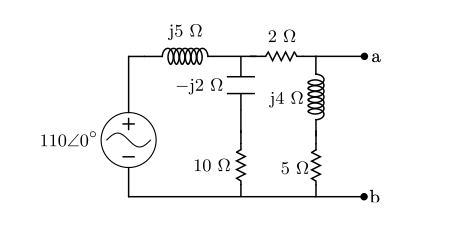
Solutions.
It is useful to consider an intermediate node. Let node between \(j5\ \Omega\) and \(2\ \Omega\) be denoted \(m\), and its voltage \(V_m\). Then applying KCL at node \(m\) and node \(a\), we have two equations
\(\begin{align} \frac{V_M - 110}{j5} + \frac{V_M - V_a}{2} + \frac{V_M}{10-j2} &= 0 \\ \frac{V_a - V_M}{2} + \frac{V_a}{5+j4} &= 0 \end{align}\) Solving for \(V_a\), we get \(V_a =V_{th} = 55.19\angle{-31.11°} \approx 47.27 - j28.62 \ \text{V}\)
To find \(Z_{th}\), we remove the voltage source (short circuit) and look into terminals a-b, and we need to find the impedance seen from a-b.
With the source shorted, from terminal a looking left through \(2 \ \Omega\) we reach node \(m\), where we see \(j5 \ \Omega\) in parallel with \((10-j2) \Omega\):
\[Z_{j5 \| (10-j2)} = 2.294+j4.312 \ \Omega\]Then adding the \(2 \Omega\) in series:
\[Z_{left} = 2 + 2.294+j4.312 = 4.294+j4.312 \ \Omega\]This is in parallel with the right branch :
\[Z_{th} = (5+j4) \Vert (4.294+j4.312) = 3.13\angle41.99^\circ = 2.326+j2.094 \ \Omega\]For the Norton equivalent, we have \(Z_{th}=Z_{N}\) and
\[I_N = \frac{V_{th}}{Z_{th}} = 17.63\angle{-73.10°} =5.12 - j16.87 \ \text{A}\]Problem 11
The circuit has the following parameters:
\[R_1 = 5\ \Omega \qquad R_2 = 250\ \Omega \qquad R_3 = 50\ \Omega\] \[L_1 = 5\ \text{mH} \qquad L_2 = 50\ \text{mH} \qquad C_3 = 500\ \mu\text{F}\]Given that the source voltage \(v(t) = 630\sqrt{2}\sin(2\pi 60t)\) V:
(a) Compute the source current, \(\bar{I}\)
(b) Compute the current \(\bar{I}_3\) flowing in the branch with \(R_3\) and \(C_3\)

Solutions.
The source voltage phasor is \(\mathbf{V}_s = 630\angle 0^\circ \text{ V}\). The impedances are \(Z_{R_1} = 5 \ \Omega\), \(Z_{L_1} = j\omega L_1 = j(376.991)(0.005) = j1.885 \ \Omega\), \(Z_{R_2} = 250 \ \Omega\), \(Z_{L_2} = j\omega L_2 = j(376.991)(0.05) = j18.850 \ \Omega\), \(Z_{R_3} = 50 \ \Omega\), \(Z_{C_3} = \frac{1}{j\omega C_3} = \frac{1}{j(376.991)(500 \times 10^{-6})} = \frac{1}{j0.18850} = -j5.305 \ \Omega\).
Parallel branch impedances are \(Z_2 = R_2 + Z_{L_2} = 250 + j18.850 \ \Omega\), \(Z_3 = R_3 + Z_{C_3} = 50 - j5.305 \ \Omega\). Their parallel combination is \(Z_{23} = \frac{Z_2 \cdot Z_3}{Z_2 + Z_3}=41.866 - j3.165 \ \Omega\).
The total impendance is \(Z_{total} = Z_{R_1} + Z_{L_1} + Z_{23}=46.866 - j1.280 \ \Omega=46.884\angle{-1.565^\circ} \ \Omega\).
a) Source Current \(\bar{I}\)
\[\bar{I} = \frac{\mathbf{V}_s}{Z_{total}} = \frac{630\angle 0^\circ}{46.884\angle{-1.565^\circ}}=13.437\angle 1.565^\circ \text{ A (rms)}\](b) The voltage across the parallel combination is:
\[\mathbf{V}_{23} = \bar{I} \cdot Z_{23} = 563.87\angle{-2.764^\circ} \text{ V}\]Then
\(\bar{I}_3 = \frac{\mathbf{V}_{23}}{Z_3} = \frac{563.87\angle{-2.764^\circ}}{50 - j5.305}= 11.214\angle 3.289^\circ \text{ A (rms)}\).