EE 554 Largescale Electric Systems Analysis Homework Assigments
Homework 1
Due Oct 9th at 11:59pm. Submit to CANVAS at https://canvas.uw.edu/courses/1917157. You should use computers when appriopriate. You are permitted to use AI, but please indicate how and where it is used.
Problem 1
We will use matrices extensively in this class, often in the context of solving linear system of equations. For the following equations, find all the solutions, or explain why there is no solution.
a) Solve \(\begin{bmatrix} 1 & 1 & 3 \\ 2 & -1 & 6 \\ -5 & 5 & 3 \end{bmatrix} x =\begin{bmatrix} 1 \\ -1 \\ 2 \end{bmatrix}\)
b) Solve \(\begin{bmatrix} 1 & 0 & 1 \\ -1 & 2 & 2 \\ 0 & 2 & 3 \end{bmatrix} x = \begin{bmatrix} 1 \\ 2 \\ 3 \end{bmatrix}\)
c) Solve \(\begin{bmatrix} 1 & 0 & 1 \\ -1 & 2 & 2 \\ 0 & 2 & 3 \end{bmatrix} x = \begin{bmatrix} 1 \\ 2 \\ 4 \end{bmatrix}\)
Solutions.
a) Solving the linear system gives
\[x=\begin{bmatrix} 1/2\\ 1\\ -1/6 \end{bmatrix}.\]b) There are infinitely many solutions:
\[x=\begin{bmatrix} 1-t\\ \frac32-\frac32t\\ t \end{bmatrix},\qquad t\in\mathbb R.\]c) The second and third equations imply
\[2x_2+3x_3=3,\qquad 2x_2+3x_3=4.\]These equations are inconsistent and there is no solution.
Problem 2
Consider the matrix \(\begin{bmatrix} 1 & 2 \\ -1 & 0 \\ 3 & 4 \end{bmatrix}\)
a) Find its null space.
b) Find its row space.
Solutions.
a) The columns are linearly independent, so the null space is zero dimensional, consist of only the \((0,0)\) vector.
b) The first two rows are linearly independent, so
\[\operatorname{Row}(A) =\operatorname{span}\{(1,2),(-1,0)\}=\mathbb R^2.\]Problem 3
Let \(A\) be some matrix. Recall that the column rank of \(A\) is the dimension of its column space, and the row rank of \(A\) is the dimension of its row space. Prove that the column rank equals to the row rank.
Soluitons.
There are many ways to show this. One way is to consider reducing \(A\) to row echelon form \(R\) using elementary row operations. These operations preserve both row rank and column rank. If \(R\) has \(r\) pivots, its \(r\) nonzero rows form a basis for its row space, while its \(r\) pivot columns form a basis for its column space.
Problem 4
Find all the eigenvalues and eigenvectors of the following matrix
\[\begin{bmatrix} 3 & -1 & -1.5 \\ -1 & 5 & -2 \\ -1.5 & -2 & 4 \end{bmatrix}\]Solutions.
The eigenvalues are approximately
\[\lambda_1=0.8983,\qquad \lambda_2=4.5336,\qquad \lambda_3=6.5681.\]Corresponding normalized eigenvectors are
\[v_1=\begin{bmatrix}0.6505\\0.4551\\0.6080\end{bmatrix},\qquad v_2=\begin{bmatrix}0.7579\\-0.4400\\-0.4816\end{bmatrix},\qquad v_3=\begin{bmatrix}-0.0484\\-0.7742\\0.6312\end{bmatrix}.\]Problem 5
In class, I said that power need to be defined as \(S=VI^*\), and things wouldn’t make sense if that \(*\) isn’t there. Why is that? What would go wrong if we define power as \(S=VI\)?
Solutions.
Without the conjugate, the number computed wouldn’t make physical sense. For example, consider a voltage across an inductor, with impedance \(jX\). The current is \(\frac{V}{jX}\), where \(V=1-j\). If we compute \(VI\), we get \(\frac{V^2}{jX}=\frac{-2j}{jX}=\frac{-2}{X}\), which means that the inductor is generating active power, and that doesn’t make sense.
Note that we didn’t show \(VI^*\) would never run into the above problem. That is a deeper result from physics.
Problem 6
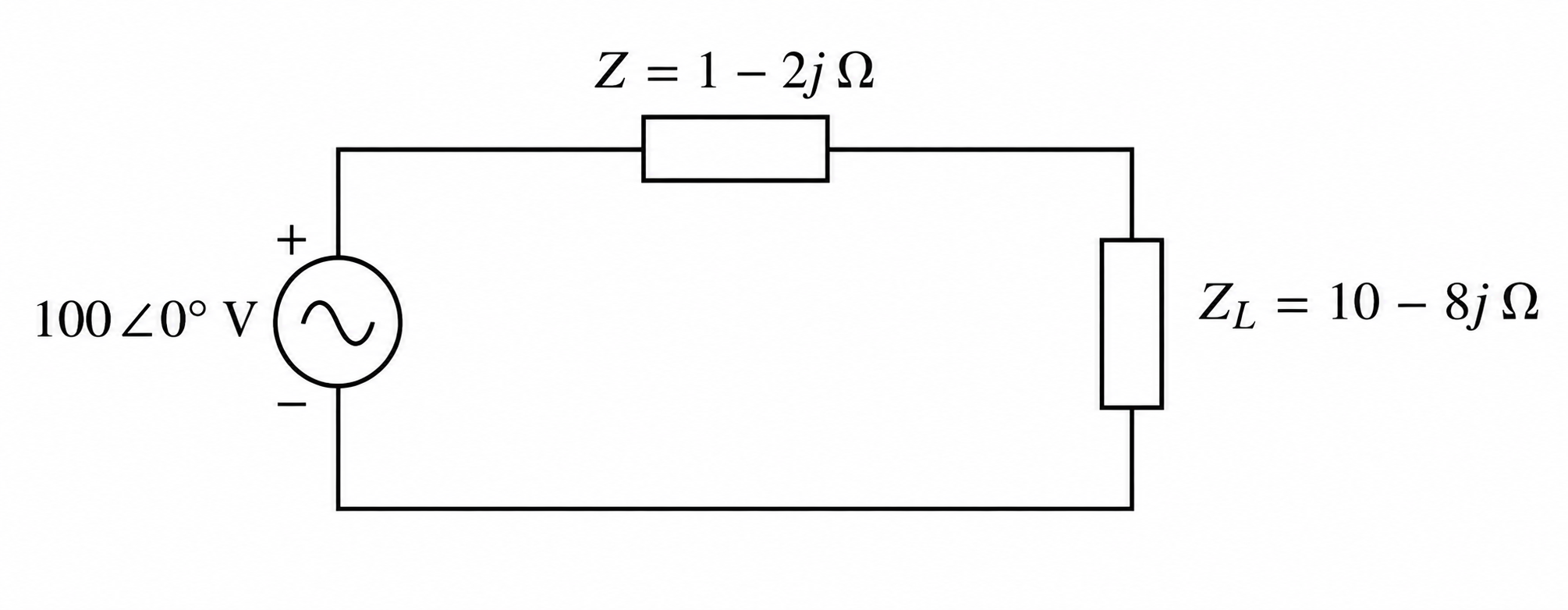
Consider the circuit below, find the current through \(Z\), and the power delivered to the load \(Z_L\).
Solutions.
The total series impedance is
\[Z+Z_L=(1-2j)+(10-8j)=11-10j\ \Omega.\]The current through $Z$ is
\[I=\frac{100\angle 0^\circ}{11-10j} =4.977+j4.525 =6.727\angle42.27^\circ\ \mathrm{A}.\]The complex power absorbed by the load is
\(S_L=|I|^2Z_L =452.49-j361.99\ \mathrm{VA}.\) And the real power delivered to the load is \(P_L=452.49\ \mathrm{W}.\)
Problem 7
Consider a setting of a generator supplying a load. Let the load be \(L\). The price of electricity is proportional to the load, that is, the price is \(\alpha L\) for some \(\alpha >0\). Now fix the load at 10 MW. We add a solar generator to the system. Because solar energy has zero marginal cost, we consider it as negative load. Let denote the amount of solar generated as \(S\), and the price is now \(\alpha (10- S)\). If you’re the owner of the solar generator, what value of \(S\) would you choose to optimize your profit?
Solutions.
The profit of solar is \(S \cdot \alpha (10-S)\), and the maximizing \(S\) is \(S^*=5\). So the solar generator would not generate more than 5 MW, even if more power is avaiable. This is a general phenonmon in renewable generation, where it is not the economic self interest of the generator to generate too much power. It also has a more celorful name in the literature, called the ``death spiral’’, which means the renewables depress the price in the system and this can lead to a feedback effect that makes profit very low. A recent example is one of the largest solar operators in Europe filing for bankruptcy. It is a centeral challenge in electricity market design with renewables, and the difficulty lies a misalignement between what’s good for a producer (more profit) and what’s good for society (low emission and low costs).